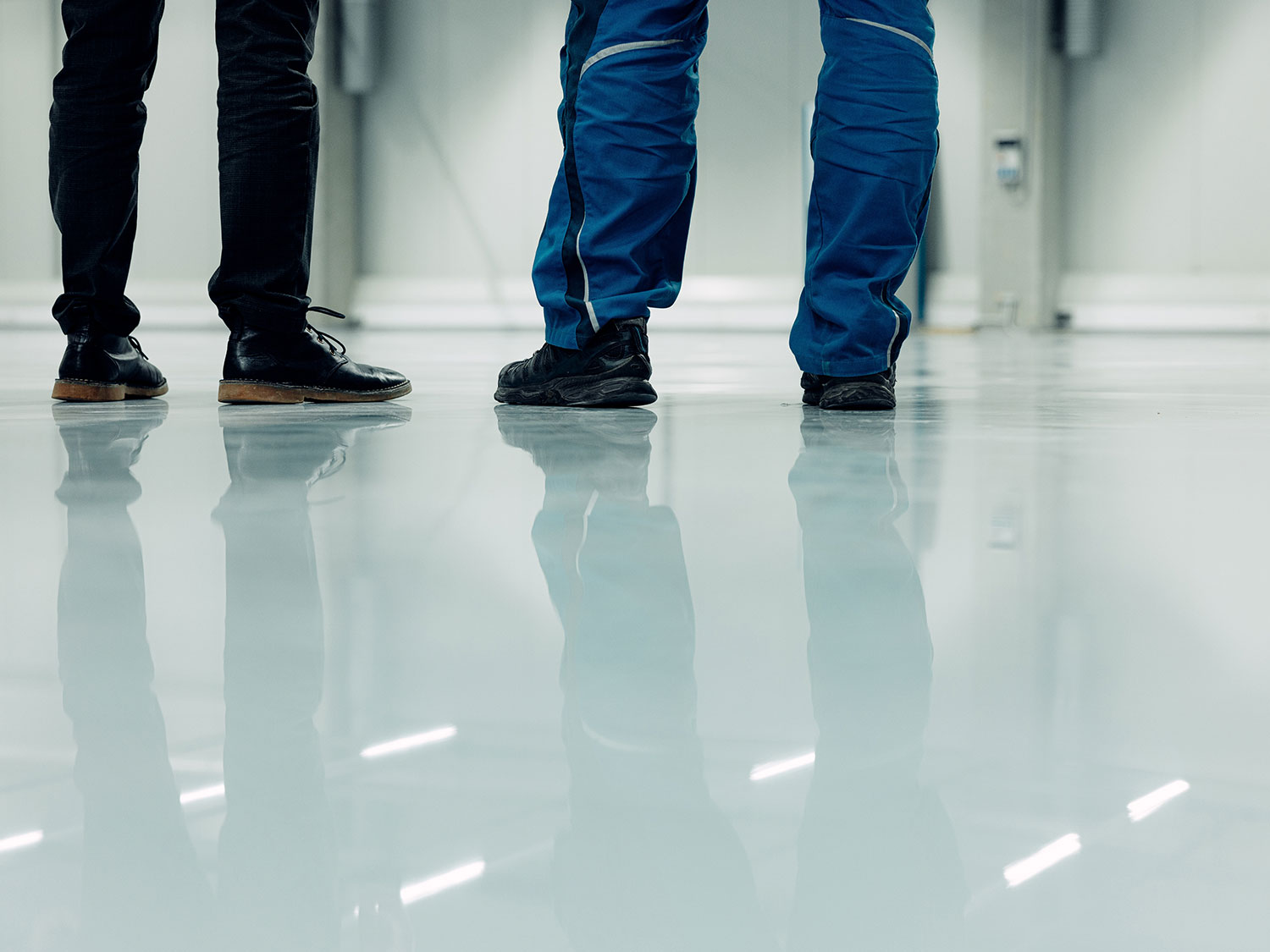
I get calls about epoxy flooring pretty regularly now. Homeowners in League City, Pearland, and all over the southeast Houston area want to know if it is worth doing. My honest answer is yes — but only if it is done right. And in this area, "done right" means one thing above everything else: dry concrete.
We are on the Gulf Coast. We get tropical storms. We get 6 inches of rain in an afternoon. And a lot of garages in this area sit on clay soil that holds moisture and pushes it up through the slab.
Epoxy is a coating, not a waterproof membrane. It bonds to the surface of your concrete. If moisture is coming up from below — even a tiny amount — that bond breaks. The coating peels. It bubbles. It delaminates in sheets.
Before we touch any garage floor, we do a moisture test. The simplest version is taping a sheet of plastic to the concrete for 24 hours and checking for condensation underneath. There are also more accurate calcium chloride tests. If the slab is wet, we wait. That is not something to rush.
After a flood or heavy rain event, I tell people to give it two weeks minimum before we start. Sometimes longer, depending on how the slab drains and what the weather looks like going forward.
Once the concrete is dry, the next big decision is how to open up the surface so the epoxy actually sticks.
There are two main approaches: diamond grinding and acid etching.
Grinding is better. A floor grinder opens the concrete pores evenly across the whole slab. You end up with a consistent profile that epoxy can grab onto. It also removes any existing sealers, stains from oil, or old paint that would block adhesion.
Acid etching — usually muriatic acid — is cheaper and faster. Some contractors use it as the default. It can work on clean, unsealed concrete that has never had anything spilled on it. But in a working garage? There is usually oil. There is usually tire rubber residue. Acid does not cut through that the way grinding does. And if any spots are missed, those are exactly where you will see peeling six months later.
We use grinding on every job. It costs a little more in time and equipment. But it is the difference between a floor that lasts and one you are calling us back to fix.
Most epoxy product sheets list cure times based on ideal conditions — around 70°F and 50% humidity. That is not Houston in the summer. Or fall. Or spring.
We are regularly looking at 85% humidity during application. That slows cure significantly. A product that says "foot traffic in 12 hours" might actually need 18 to 24 hours here before it is ready. And full cure — the point where you can park a car on it without risk of impressions — often takes 5 to 7 days instead of the 3 days listed on the can.
We watch the weather when we schedule these jobs. You do not want rain moving in while the floor is still curing. You do not want to open the garage door wide on a humid day and have moisture settle on a tacky surface. Timing matters a lot here.
This one frustrates me. A lot of what gets sold at hardware stores as "epoxy floor paint" is not the same product as a proper two-part epoxy coating.
Floor paint — sometimes called traffic paint or porch-and-floor paint — is a single-component product. It goes on thin, dries fast, and looks fine for about a year. Then it scuffs, chips, and peels. Cars rolling on it will leave marks. Hot tires will lift it.
A real epoxy floor coating is a two-part system — resin and hardener that you mix before application. It goes on at 3 to 10 mils thick depending on the product and number of coats. It is chemically resistant, hard, and bonds to concrete at a molecular level when prepped correctly.
The two products look similar in the can and on the shelf. The performance difference after two years of use is massive. If someone quotes you a very low price for an epoxy job, ask them what product they are using and how thick the dry film build will be. Those two questions tell you a lot.
A standard two-car garage in this area runs roughly 400 to 500 square feet of floor space. For a proper surface-ground, two-part epoxy system with a broadcast flake finish, you are typically looking at $1,500 to $2,800 installed.
That range depends on the condition of the concrete, whether cracks or spalling need patching first, and what finish system you are going for. A solid color base coat with a clear topcoat is on the lower end. A full decorative flake system with a urethane topcoat runs higher.
There are cheaper quotes out there. If someone is quoting you $700 for an epoxy garage floor, they are either skipping the grind, using a single-component floor paint, or both. You will know within a year.
For more on what we offer, see our flooring services page.
With proper surface prep and a quality two-part product, a residential garage floor in this area will realistically last 5 to 7 years before it needs a recoat or touch-up. Some go longer. Commercial shops and high-traffic areas see more wear and might need attention sooner.
What shortens the life:
What I see when prep is skipped is not subtle. Edges start to lift within months. Then bubbles appear where moisture was trapped underneath. Then large sections pop loose. At that point the floor has to be stripped and done again — which costs more than doing it right the first time.
And the frustrating part is that a lot of those failures get blamed on "cheap epoxy." But it is almost never the product. It is the prep. Wet concrete, no grind, no profile — the best epoxy in the world will not stick.
If you are thinking about epoxy for your garage or shop in the Houston area, call me. I will come out and look at the slab, talk through prep, and give you a real number. No surprises.
We serve League City, Pearland, and the greater Houston area. Call or text for a free on-site estimate — we will check the slab and give you a straight answer.
Get a Free Estimate (713) 517-8136